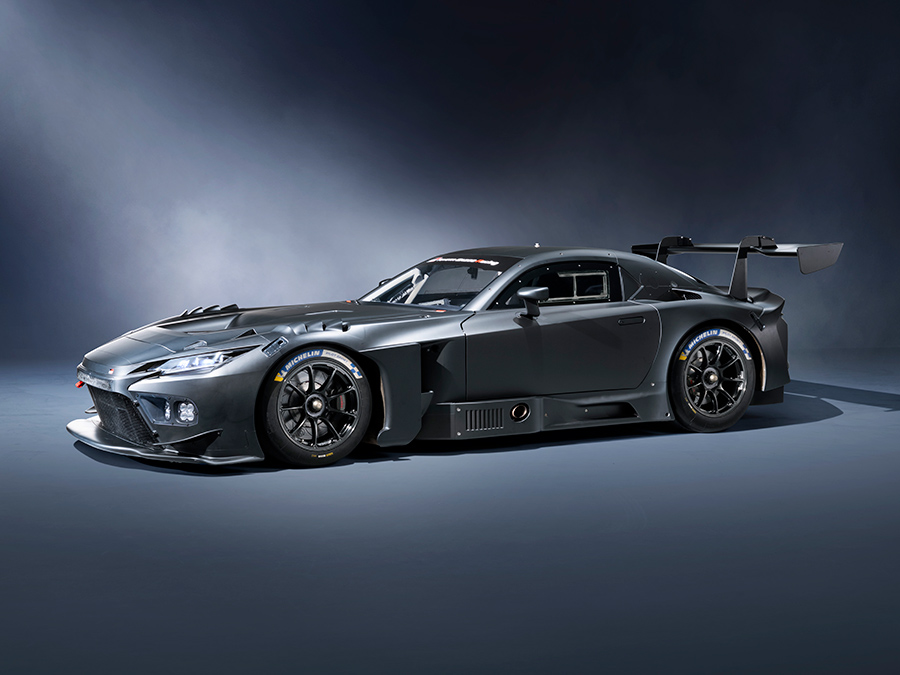
Toyota has spent years doing just enough in performance to keep enthusiasts hopeful without quite giving them the flagship road car many wanted. The GR GT changes the tone. It does not feel like a speculative concept built to generate noise around the brand. It feels like Toyota finally deciding that its racing identity deserves a road-legal centerpiece serious enough to back the talk.
The most important detail is the powertrain. Toyota says the GR GT uses a hybrid system built around a newly developed 4.0-liter V8 twin-turbo engine paired with a single electric motor. Development targets are quoted at 650 PS or more and 850 Nm or more, with a top speed in excess of 320 km/h. Those are serious numbers, but what makes them more interesting is how they are packaged. The engine uses dry-sump lubrication, the heavy hardware is positioned with obsessive attention to center of gravity, and the transaxle sits at the rear to help deliver a 45:55 front-to-rear weight distribution.
That layout tells you Toyota is chasing more than a straight-line statement. The official language repeatedly returns to the idea of car-driver unity, which sounds like marketing until you read the chassis brief more closely. The GR GT was developed with the driver seated as low as possible, the overall vehicle height reduced aggressively, and the major components packaged so the car remains stable and communicative at the limit. In other words, this is not being sold as a digital-age missile that flattens a drag strip and then loses its personality. Toyota wants it to feel adjustable, trustworthy and alive.
The GR GT also stands out because the design process ran in reverse compared with a normal road car. Toyota says aerodynamic engineers with FIA WEC experience established an ideal aerodynamic model first, and exterior designers then worked around that form with mass production in mind. That is exactly the kind of engineering-led decision enthusiasts always say they want manufacturers to make and rarely get to see executed on a flagship car. It suggests the GR GT is not trying to mimic the image of a race car. It is trying to preserve the logic of one.
Structurally, the car is equally ambitious. Toyota highlights a lightweight, high-rigidity all-aluminum body frame, the active adoption of new manufacturing methods, and a multi-material construction strategy aimed at keeping the car low, rigid and responsive. Even the soundtrack has been treated as part of the engineering brief rather than an afterthought, with the exhaust system tuned to produce a V8 note that reinforces the driver's sense of what the powertrain is doing in real time. That kind of detail is not fluff in this segment; it is part of what separates an event car from an expensive object.
The bigger picture is what makes the GR GT so important. Toyota already builds fast cars, capable hot hatches and serious homologation specials, but the GR GT pushes the brand into a different conversation. It says Toyota believes a global mainstream manufacturer can still build an uncompromising flagship without apologizing for emotion, speed or technical extravagance. If the final production car preserves the mechanical honesty promised by this prototype and carries that same motorsport logic onto the road, the GR GT could become one of the most significant Japanese performance cars of the decade.