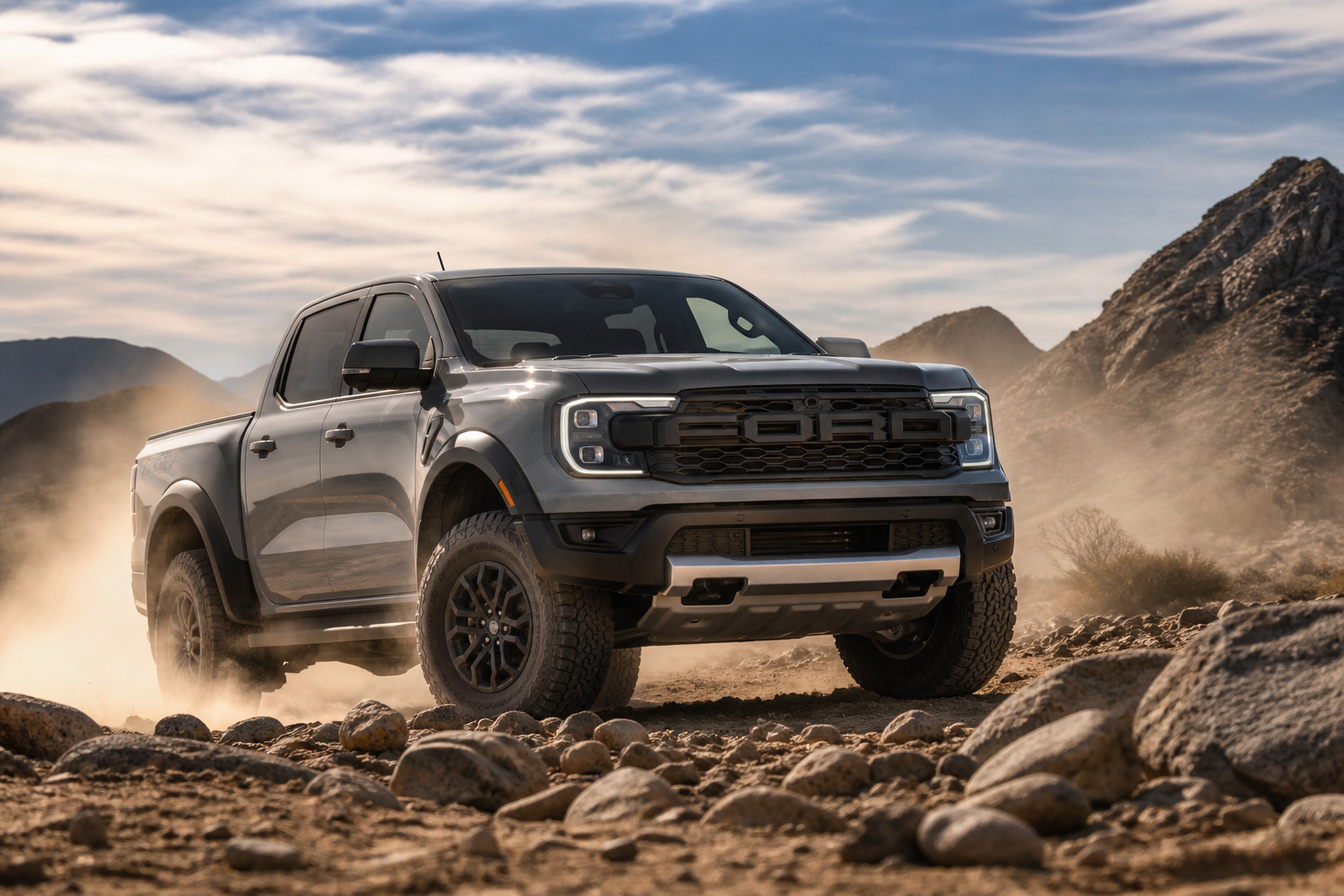
The F-150 Raptor is a vehicle that requires a particular kind of road environment to use properly — open American desert or ranch roads where its 13-inch suspension travel and 450 hp twin-turbocharged engine can be exercised without endangering other road users. The Ranger Raptor packages the Raptor philosophy into a mid-size pickup that fits in European multi-storey car parks, complies with urban traffic flow, and passes through market segments where full-size American trucks are commercially impractical. It does this without meaningfully diluting the performance case.
288 Horsepower V6: The Engine the Previous Raptor Deserved
The second-generation Ranger Raptor's most significant upgrade over the EcoBlue diesel first generation is the engine. The 3.0-litre twin-turbocharged V6 EcoBoost produces 288 hp and 491 Nm — numbers that would have been described as performance car territory in any pickup truck context a decade ago. The V6 delivers power across a wide rpm range without the surge-and-wait character of smaller-displacement turbocharged units, and the exhaust note at full throttle is the first Ranger engine sound worth noting in isolation.
The ten-speed SelectShift automatic manages the V6's output with shift logic that adapts to the selected drive mode. In Baja mode — named for the Baja 1000 desert race that the Raptor's suspension tuning is calibrated to survive — the transmission holds gears longer, the throttle mapping sharpens, and the stability control is reduced to a point that allows controlled slides on loose surfaces without completely removing the safety net.
Fox Live Valve Suspension: The Technical Achievement
The Ranger Raptor's Fox Live Valve dampers adjust their compression and rebound rates in real time — 500 times per second — based on road surface inputs from accelerometers at each corner and data from the vehicle's inertial measurement unit. The system is designed to maintain optimal damping during high-speed off-road travel, where the suspension is asked to absorb large inputs at speeds where conventional adaptive dampers cannot respond quickly enough.
Suspension travel is 13 inches at the front and 13.6 inches at the rear — enough to clear obstacles and maintain wheel contact with uneven terrain at speeds that would otherwise launch a conventional pickup airborne. Ground clearance is 283 mm in standard configuration; approach angle is 32.5 degrees.
On Road: The Penalty You Accept
The Ranger Raptor's off-road capability comes with predictable on-road trade-offs. The wide-track chassis and 33-inch BF Goodrich All-Terrain tyres produce a turning radius that requires anticipation in tight urban environments. Fuel consumption in mixed driving rarely drops below 13 L/100km. The suspension compliance at motorway speed is better than the travel figures suggest, but there is never any ambiguity about the vehicle's priorities.
For buyers who accept these trade-offs — and the Ranger Raptor's strong sales suggest many are willing to — the return is the most driver-engaging mid-size pickup truck available in any market where it is sold. The Raptor nameplate has earned credibility through the F-150 version's desert racing results, and the Ranger carries that credibility at a scale and price point that makes it the accessible expression of a genuinely extreme capability.