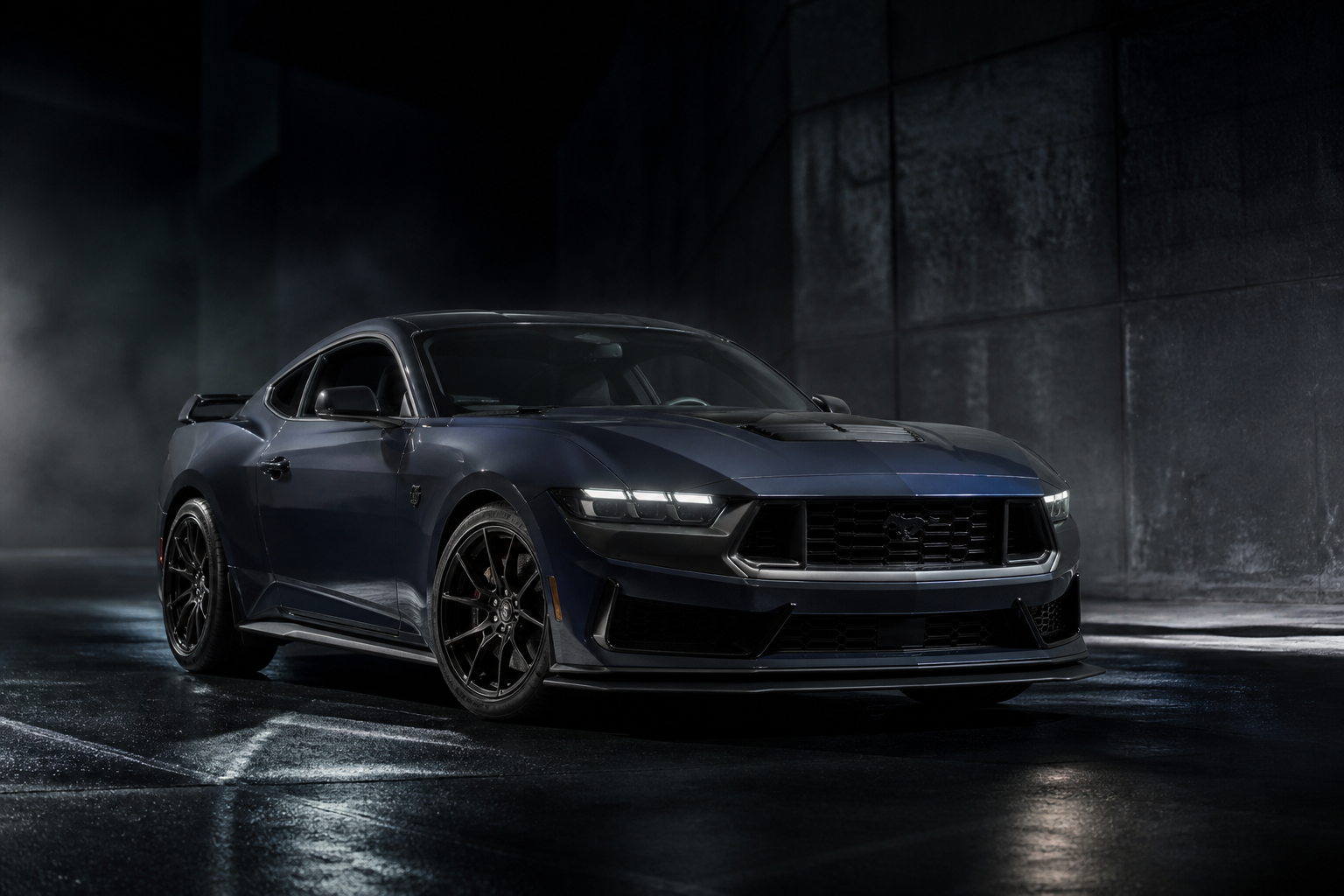
The Ford Mustang has existed in various forms since 1964, and in that time it has been a cheap car, an expensive car, a performance car, a fuel crisis casualty, and a global cultural artefact. The seventh-generation S650, introduced in 2024, adds a new position to that list: a genuinely serious driver's car available in a market that has never rewarded seriousness from a Mustang as consistently as it has rewarded nostalgia and visual drama. The Dark Horse trim is Ford's answer to the question of what happens when you build a Mustang without compromise.
500 Horsepower: The Coyote V8 at Its Most Committed
The Dark Horse uses a version of Ford's 5.0-litre Coyote V8 that is specific to this trim — hand-assembled, with flat-plane crank characteristics that produce a higher-revving, more acoustically dramatic power delivery than the standard GT's engine. Output is 500 hp at 7,500 rpm and 418 lb-ft of torque at 4,500 rpm. The redline of 7,750 rpm is the highest of any naturally aspirated Mustang V8, and the engine note at full throttle is the kind of sound that justifies the absence of an artificial soundtrack generator entirely.
The six-speed Tremec manual gearbox is standard; the ten-speed SelectShift automatic is optional for buyers who want the engine without the engagement. Ford's performance engineers recommend the manual — not as a matter of principle but because the gear ratios, chosen specifically for the Dark Horse application, are spaced to keep the engine in its power band during track use in a way the automatic's programming cannot replicate with the same consistency.
Chassis: MagneRide and Brembo as Standard Equipment
The Dark Horse receives MagneRide 4.0 adaptive dampers as standard — a system that adjusts damping rates in real time based on wheel velocity, body motion, and driver input. The calibration for the Dark Horse is significantly stiffer than the GT's optional MagneRide tune, producing a car that manages body roll with authority at the cost of urban ride quality that requires acceptance rather than enjoyment.
The braking system is a genuine highlight: six-piston Brembo front calipers gripping 380 mm rotors, paired with four-piston rears. Brake feel is progressive, fade resistance is excellent during extended track use, and the pedal travel is calibrated for drivers who brake late rather than for commuters who modulate pressure from a distance. These are brakes that belong on a car that costs considerably more.
Track Pack: The Specification That Completes the Argument
The optional Track Pack adds wider front tyres — 305/30 ZR19 front, 315/30 ZR19 rear — a front splitter, rear wing, and a Torsen limited-slip differential recalibrated for circuit use. With the Track Pack fitted, the Dark Horse laps the Nürburgring Nordschleife in times that put it in the same conversation as German sports cars costing twice the asking price. Without it, the Dark Horse is still a remarkable car. With it, the Dark Horse becomes an argument about value that is difficult to counter from any angle.
The Mustang That Had to Exist
Ford builds the Mustang GT500 for buyers who want the most powerful car in the range. The Mach 1 was built for buyers who wanted balance. The Dark Horse is built for drivers — specifically, the driver who knows the difference between a fast car and a well-sorted car, and who has decided that the second quality matters more than the first. In a sports car market that is becoming increasingly electrified and increasingly softened by driving assistance systems, the Dark Horse is the unqualified reminder that the naturally aspirated, manual-gearbox, rear-wheel-drive sports car is not an endangered species — it is just becoming rare enough to matter more.