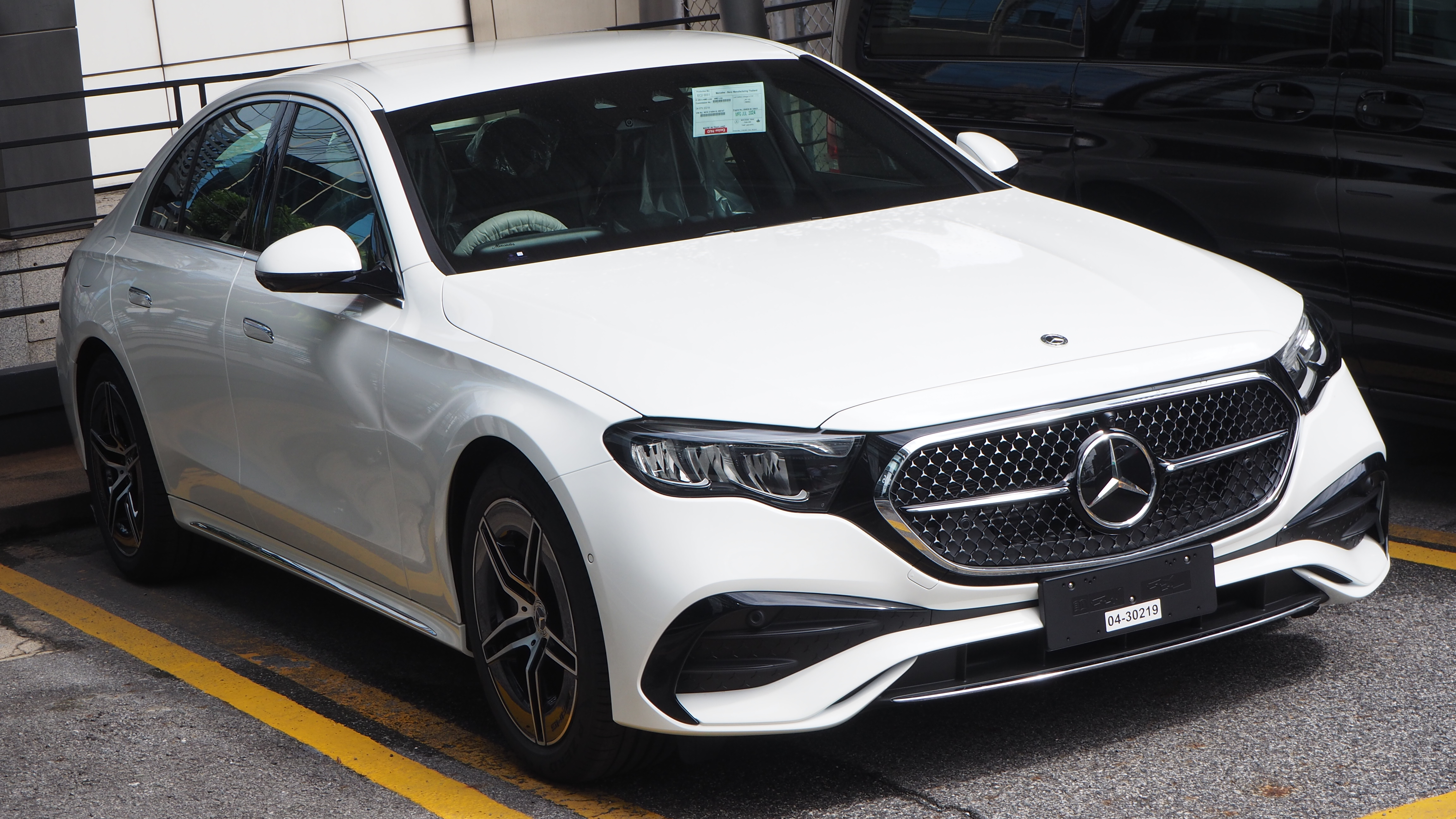
The Mercedes-Benz E-Class has been the world's best-selling premium sedan in most of the years since its W123 introduction in 1975. It is the car against which BMW calibrates the 5 Series, Audi measures the A6, and every other executive sedan positions itself when making a value claim. The W214 generation, introduced in 2023 and now fully available across its model range, represents the most ambitious interior upgrade in the E-Class's modern history — a car that has deliberately borrowed technology, space, and ambience from the W223 S-Class in ways that make the previous W213 generation look like a stepping stone rather than a product in its own right.
The Interior: S-Class Ambition at E-Class Volume
The W214's defining feature is its dashboard architecture. The MBUX Superscreen occupies the full width of the instrument panel — a single glass plane housing the 12.3-inch driver display, the 14.4-inch central MBUX screen, and an optional 11.6-inch passenger screen that can display content independently of the driver while the car is in motion, with a camera system that prevents the passenger display from projecting onto the windscreen in the driver's field of view.
The ambient lighting system uses 255 individual LEDs across 64 colour options and is capable of projecting visual effects — including animated patterns, weather representations, and navigation cues — onto the display glass and onto the door panels simultaneously. This is technology that was S-Class-exclusive eighteen months ago, and its presence in a car priced from approximately €65,000 changes the competitive calculus in the executive sedan segment entirely.
Material quality is consistent with the visual ambition. The standard seat upholstery is a leatherette-and-fabric combination that looks good in press photography and less convincing in person at the base specification. However, the AMG Line and Exclusive specification packages introduce Nappa leather, polished wood trims from the Manufaktur catalogue, and a flat-bottomed steering wheel with capacitive touch-sensitive control surfaces that feel genuinely premium rather than performative.
The Plug-in Hybrid Case: 100km of Real Range
The E 300 e and E 400 e plug-in hybrid variants represent the most complete expression of what the W214 is designed to do in the current regulatory environment. The E 300 e pairs a 204 hp 2.0-litre four-cylinder with a 129 hp electric motor and a 25.4 kWh battery, producing a system output of 313 hp and — critically — an WLTP electric range of approximately 100 km. In a segment where many plug-in hybrids offer 40-60 km of electric range and are purchased primarily to satisfy company car tax incentives, the E 300 e's 100 km range creates a different product proposition: a car that can complete the majority of average daily commutes on electricity alone.
The transition between electric and combustion operation is managed by the EQ Power control unit, which uses navigation data, battery state of charge, and driving style profiling to plan energy usage across an entire journey. If the navigation knows you are approaching a city centre with a 30 km/h zone, the system pre-charges the battery on the preceding motorway section using mild regeneration to maximise the electric distance available in the restricted area. It is a system that rewards drivers who use it consistently over those who treat the battery as a backup.
Diesel and Petrol: The Volume Majority Still Matters
The E 220 d — a 197 hp 2.0-litre diesel — will account for the majority of European W214 sales in markets where diesel is still commercially viable. It is a good engine: smooth enough that its diesel provenance is genuinely undetectable without instrumentation, economical enough to return sub-5 L/100km in careful motorway driving, and torque-rich enough that overtaking manoeuvres on single-carriageway roads require no anticipation.
The petrol range begins with the E 200 at 204 hp and extends to the E 450 4MATIC at 381 hp — the same M256 inline six that appears in the CLE Coupe and C-Class AMG applications. The 450 variant is the choice for drivers who find the diesel's NVH acceptable but require performance headroom for autobahn use; it is substantially more engaging than the four-cylinder petrol without requiring the compromise on refinement that the 400 e plug-in's hybrid system occasionally imposes during higher-load transitions.
Chassis: Competence Without Drama
The W214 rides on a heavily revised version of the MRA II platform — the architecture shared with the CLE and the C-Class — with revised front strut geometry, a multi-link rear suspension, and standard passive dampers at the base of the range. The optional Airmatic air suspension with continuous adaptive damping is the specification that changes the car's character from competent to genuinely impressive: at motorway speed in Comfort mode, the W214 with Airmatic absorbs surface variations with an isolation quality that few competitors in the class can match.
Steering is accurate but not communicative — a calibration choice that reflects the majority use case of the E-Class as a business mile car rather than a driver's car. The balance is appropriate for the brief: confidence is immediate, there is no unpredictability, and the rear-wheel drive default on non-4MATIC variants gives the car a neutral character in dry conditions that makes it rewarding to drive quickly on empty roads without ever demanding precision in normal use.
The Competitive Position: The E-Class Has Always Been the Reference
The W214 E-Class arrives in a market where the BMW 5 Series G60 — a competitor with its own very strong PHEV offering and the largest screen in any BMW — and the Audi A6 e-tron are both making serious claims to segment leadership. Mercedes has responded by positioning the W214 interior above where any E-Class has historically sat, using S-Class technology to establish the most visible benchmark in the segment. Whether you prioritise the BMW's more driver-focused character, the Audi's electric-only credentials, or the Mercedes's interior theatre, the W214 has moved the baseline for what an executive sedan is supposed to look like from the driver's seat. The rest of the segment is calibrating against it.