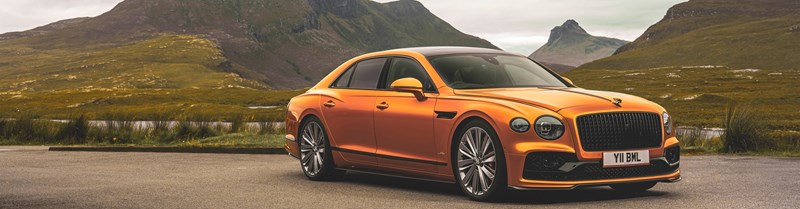
The Flying Spur Speed used to be easy to explain. It was the Bentley for buyers who wanted the company's full luxury treatment but preferred their opulence with a harder edge. The newest version pushes the idea further than that. With hybrid torque, meaningful electric range, and the sort of pace that once belonged to dedicated exotics, it now feels less like a quick limo and more like a grand touring machine that happens to have four doors.
The reason is the new Ultra Performance Hybrid powertrain. Bentley’s latest Flying Spur Speed combines a 4.0-litre twin-turbo V8 with an electric motor for a total of 782 PS and 1,000 Nm. Officially, it reaches 60 mph in 3.3 seconds, offers up to 47 miles of electric range and can travel as much as 515 miles between refuelling stops. Those are not incremental numbers. They make the current car meaningfully stronger, faster and cleaner than the outgoing W12-powered Speed, which is a remarkable sentence for a Bentley sedan to earn.
What matters even more is how Bentley has used electrification. This is not a cautious efficiency-first hybrid meant to soften the character of the car. The electric side of the system is there to widen the operating window of the Flying Spur: silent and genuinely usable in urban running, then brutally effective when the driver asks for everything at once. Bentley says the hybrid system improves torque delivery throughout the rev range, and that claim fits the broader positioning of the car. The Speed is supposed to be both more relaxed and more dramatic, not one at the expense of the other.
The chassis story helps justify that ambition. Bentley pairs the powertrain with all-wheel steering, Bentley Dynamic Ride and Performance Active Chassis technology, which means the Flying Spur Speed is being engineered less like a stately limousine and more like a large, highly intelligent performance car. That matters because the biggest challenge for ultra-luxury sedans is no longer straight-line speed; it is how convincingly they can hide mass, isolate the cabin and still feel precise enough that the driver wants to take the long way home.
The cabin, meanwhile, remains recognisably Bentley in the most strategic way possible. The materials, quilting, stitching and wellness-seat options are not there simply to prove craftsmanship; they are part of the reason the Flying Spur still has an identity distinct from high-output rivals. In an era when performance sedans are becoming increasingly software-defined, Bentley’s advantage is that it still makes speed feel ceremonial. The car’s luxury does not apologize for the performance, and the performance does not undermine the luxury.
That is why the Flying Spur Speed feels so relevant right now. It is a reminder that electrification at the top end does not have to mean sanitisation. Bentley has used the hybrid transition to make its four-door flagship more complete: quicker than before, dramatically lower in emissions, capable of silent EV running and still full of the weight, theatre and craftsmanship people expect from Crewe. In other words, the formula has not been diluted. It has been sharpened.