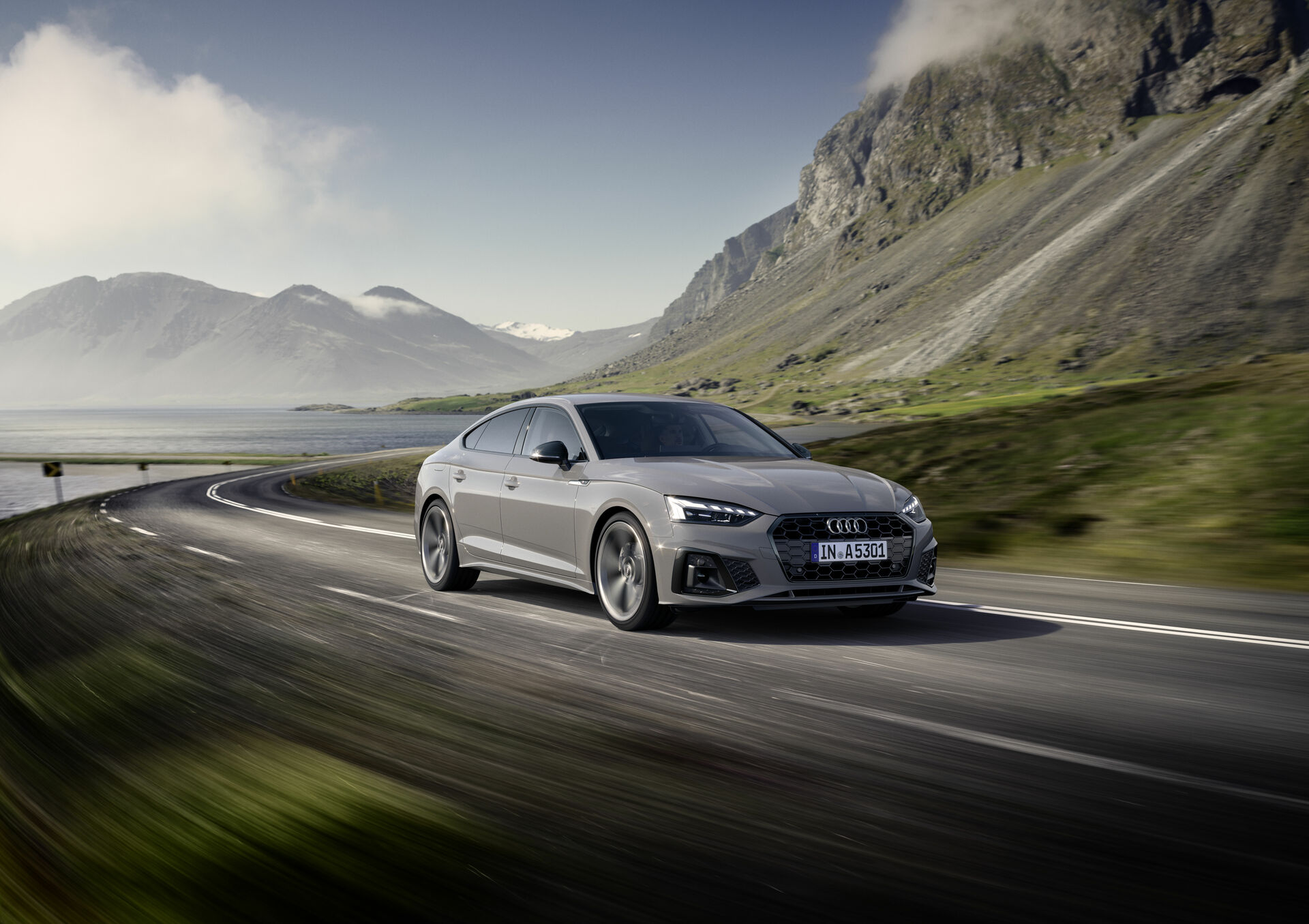
The new A5 Sportback matters because Audi has stopped treating the middle of its range as a place for careful evolution. This car does more than replace the A4. It resets the brief with more space, a clearer premium stance, and a product strategy aimed at making Audi's core midsize offering feel deliberate again rather than merely familiar.
The Name Change Signals the Intent
Audi's decision to retire the A4 nameplate and replace it with A5 is partly about internal product positioning — the new car is longer, wider, and positioned slightly upstream of the outgoing A4 — and partly about signalling. The A5 nameplate, previously reserved for the two-door coupe and cabriolet variants, carries a different register in the brand's emotional hierarchy. It suggests that the sports coupe DNA is now embedded in the mainstream midsize product rather than separated from it.
Whether that reading is accurate or not, the external dimensions support the upgrade narrative. The A5 Sportback is 42 mm longer than the B9 A4 Avant, 23 mm wider, and sits 17 mm lower. The wheelbase extends by 17 mm, which contributes to rear passenger space that is finally credible against the 3 Series Touring.
MHEV Standard: Audi Answers the BMW X3's Electrification Move
Every A5 Sportback petrol variant ships with Audi's 48-volt mild hybrid system as standard equipment. The belt-alternator-starter produces up to 25 hp of assist torque and enables extended engine-off coasting between 55 and 160 km/h — a range Audi's engineers describe as covering the majority of motorway driving conditions where combustion adds little net efficiency. The system integrates with the predictive efficiency assistant, which reads navigation data to pre-position the drivetrain ahead of deceleration zones.
The base 35 TFSI uses a 150 hp 1.5-litre four-cylinder; the 40 TFSI steps to a 204 hp 2.0-litre. For performance-oriented buyers, the S5 Sportback produces 367 hp from a 3.0-litre six-cylinder. The diesel 35 TDI at 163 hp rounds out the initial lineup in markets where diesel remains commercially viable.
Interior: The Second-Generation MMI Display Architecture
The A5 Sportback adopts Audi's current curved MMI display arrangement: an 11.9-inch driver display and a 14.5-inch infotainment touchscreen sharing a single housing, with a separate 10.9-inch climate and convenience screen below. The interface uses the MMI Operating System 2.0 introduced on the Q6 e-tron, which reorganises frequently used functions closer to the display surface and reduces the number of menu layers required for common adjustments.
The physical ambience of the interior marks a genuine step from the B9. Material selection is more consistent, the ambient lighting system has fifteen zones and 30 colour options, and the acoustic package — standard on mid-range and above — produces a cabin NVH profile that is genuinely competitive with the BMW 3 Series. Rear passengers benefit from the wheelbase extension primarily in knee room; headroom is unchanged but remains adequate for occupants up to 185 cm.
Chassis: What the MLB Evo Platform Still Delivers
The A5 Sportback rides on a revised MLB Evo platform — the same architecture underlying the Q5 and A6 — with revised subframe mounts, a new steering rack with variable ratio, and optional adaptive dampers. The standard suspension calibration prioritises comfort on the basis that most A5 Sportback buyers will spend more time in traffic than on mountain roads, but the optional Audi Drive Select system with dynamic mode tightens body control meaningfully when asked.
Progressive steering, optional on previous A4 generations, is now standard from the base trim. The steering ratio at centre is 13.9:1, quickening to 9.5:1 at full lock — a change that transforms town manoeuvring without introducing the nervous-on-centre quality that plagues some variable-ratio implementations.
The Market Case: Why the A5 Sportback Needs to Work
Audi's financial performance has been challenged by production disruptions, software delays in its electric vehicle lineup, and the ongoing margin compression associated with transitioning a premium model range toward electrification. The A5 Sportback — as the volume middle of the range — carries a disproportionate share of the responsibility for stabilising the brand's profitability while the Q4 e-tron, Q6 e-tron, and A6 e-tron build their sales volumes. It is a car that needs to sell in large numbers to justify the platform investment, and on the evidence of the specification sheet, it has the right components to do so.